Pearl watches have a strange kind of consistency to them. Ask someone where they got theirs and the answer is rarely “I saw it trending” — it’s usually something closer to “it was my mother’s,” or “I just liked how it looked,” or “I wasn’t really looking for a watch, but I saw this one.” That’s a different kind of popularity than the kind built on a single viral moment. It’s quieter, slower, and it’s been accumulating for a long time rather than spiking all at once.
Part of that has to do with the watch itself. But a good part of it, it turns out, has very little to do with the watch at all — and everything to do with the material that happens to be sitting on it. Understanding that difference changes the whole question. It’s not really “why did this particular watch design catch on,” it’s “why did a material with this much built-in goodwill ever need to convince anyone of anything in the first place.”
Pearls Were Already Popular, Long Before the Watch
Before pearls ever showed up on a watch strap, they were already one of the most reached-for materials in jewelry, full stop. Necklaces, earrings, rings, hair pieces, bracelets — pearls have had a place in almost every category of jewelry for a very long time, across a very wide range of styles and occasions. That’s not a small detail. It means a pearl watch isn’t starting from zero and trying to convince anyone that pearls are worth liking. It’s simply taking a material people already reach for, in a dozen other forms, and applying it to one more.
That matters because building appeal from scratch is genuinely hard. Most new accessory categories have to work for their popularity — a new silhouette, a new finish, a new stone has to earn recognition one wearer at a time before it becomes a familiar, trusted choice. Pearls skip almost all of that groundwork. Someone who has never owned a pearl watch in their life still has a fairly immediate, intuitive sense of what pearls look like and how they feel to wear, because they’ve likely already seen them, or worn them, in some other form. The watch isn’t introducing a new taste. It’s meeting an existing one halfway.
That’s a big part of why the category never really had to “break out” the way a genuinely new design idea does. It didn’t need an influencer moment or a marketing campaign to explain what it was going for. It borrowed a reputation that pearls had already spent a very long time building elsewhere, and it simply put that reputation to work in a new, useful format.
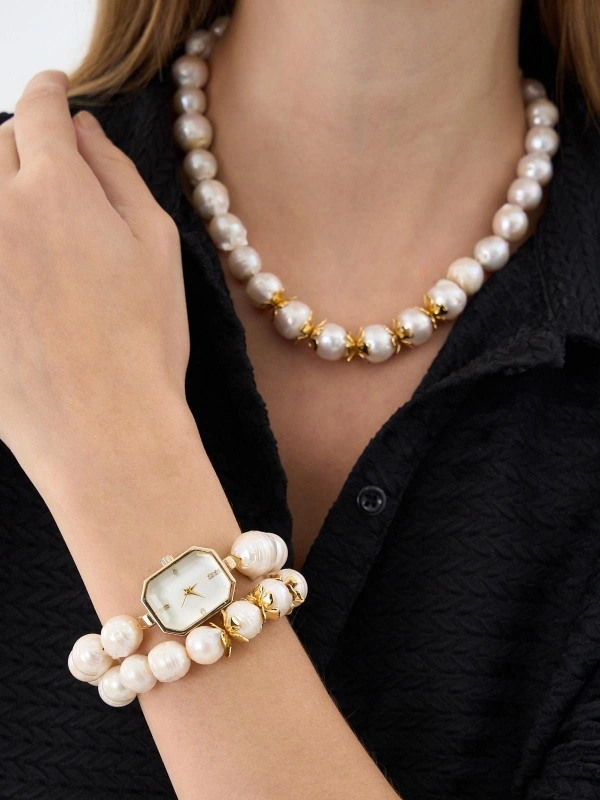
Model wearing freshwater pearl watch paired with matching pearl necklace
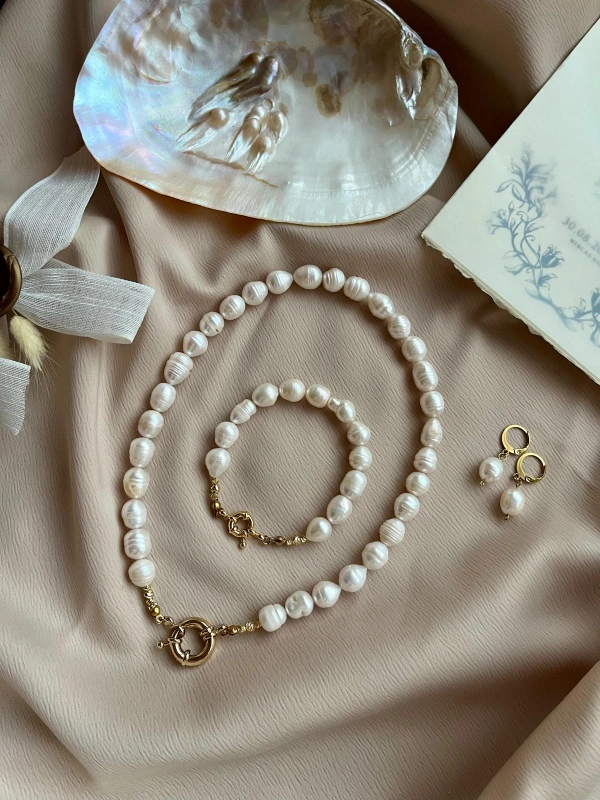
Freshwater pearl necklace, bracelet, and earrings styled on silk backdrop1
Pearls Read as Jewelry First, Watch Second
That inherited familiarity shows up clearly the moment you actually look at one. Most watches are tools that happen to look nice. A pearl watch tends to work the other way around — it reads as jewelry that happens to tell time, and that small reversal changes a lot about how people relate to it.
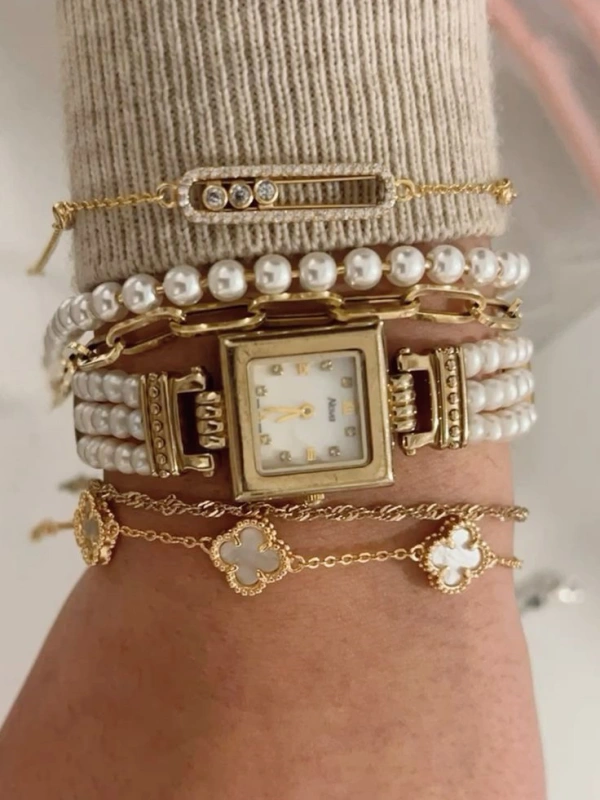
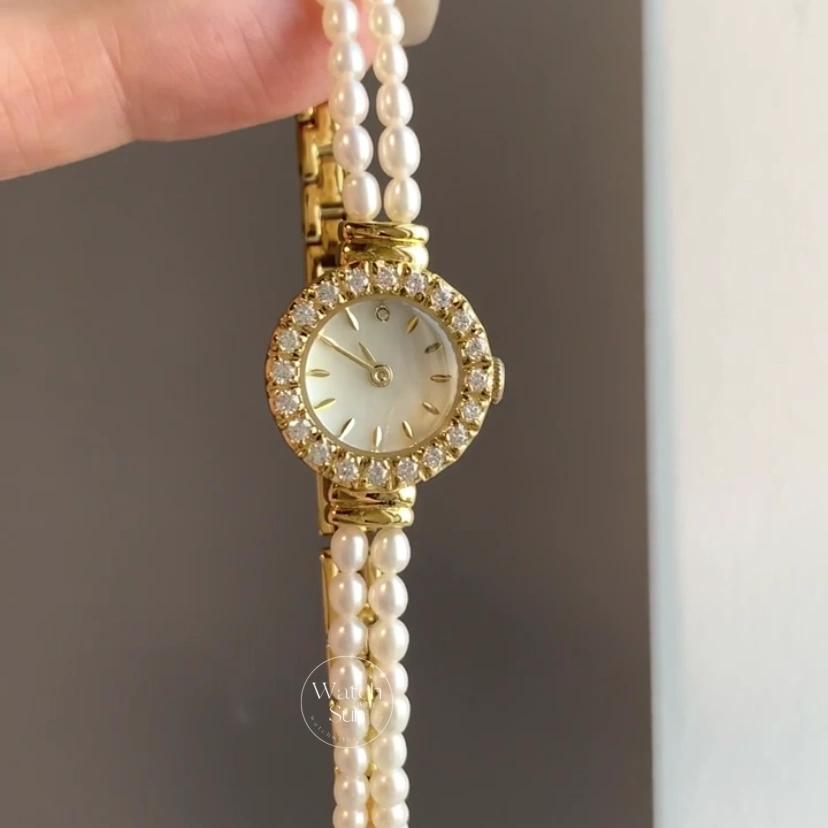
A double strand of pearls wrapped around the wrist, broken up by small gold links, already looks complete before you even notice there’s a dial in the middle. That’s not an accident of design so much as a function of what pearls are used for everywhere else. When that same material shows up on a watch, the watch inherits all of that visual language. It doesn’t read as “a watch with some pearls added.” It reads as a piece of jewelry that happens to include a small, useful detail.
That distinction solves a real, practical problem, too. Most people don’t want to layer a watch, a bracelet, and a bangle all on the same wrist — it gets busy, and jewelry tends to compete rather than cooperate once you stack enough of it in one place. A pearl watch sidesteps that entirely. It’s doing the job of a bracelet and a watch at the same time, which means one fewer decision every morning and one fewer thing clinking against the desk during the day.
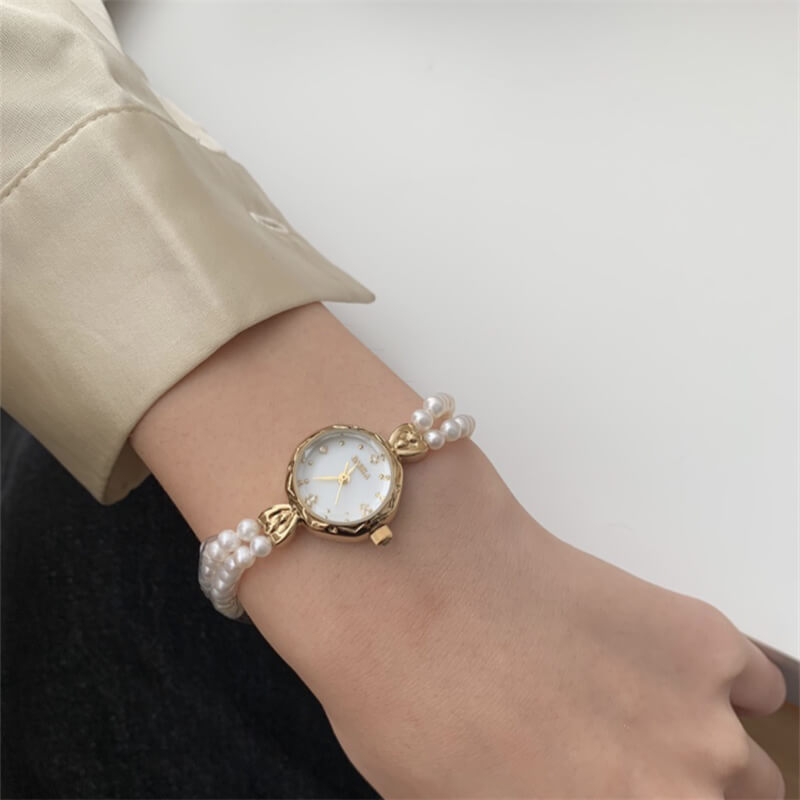
Dainty Gold Round Freshwater Pearl Bracelet Ladies Watch
The Texture Contrast Between Pearl and Metal
There’s also something happening visually that’s easy to feel and harder to name. Pearls are soft — round, matte-adjacent, slightly uneven if they’re the real thing, catching light in a diffuse glow rather than a sharp reflection. Gold, especially when it shows up as small structured bar links between the pearls, is the opposite: hard edges, a polished shine, straight lines breaking up the organic curve of the strand.
Put those two textures next to each other and you get a kind of visual rhythm that neither material produces on its own. A strand of pearls by itself can start to look uniform after a certain length — pretty, but a little repetitive. A chain of gold links by itself can feel cold or overly precise. Alternating the two breaks up that monotony without needing to add a third material or a louder design choice.
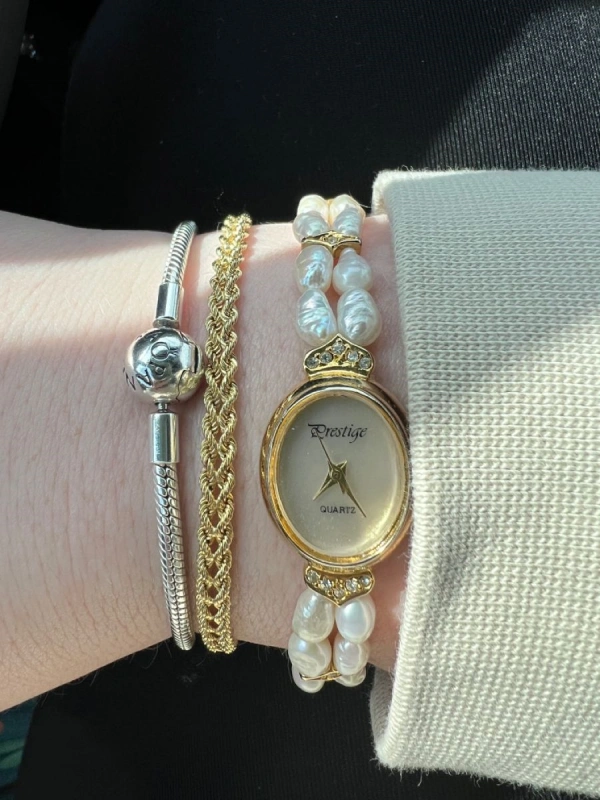
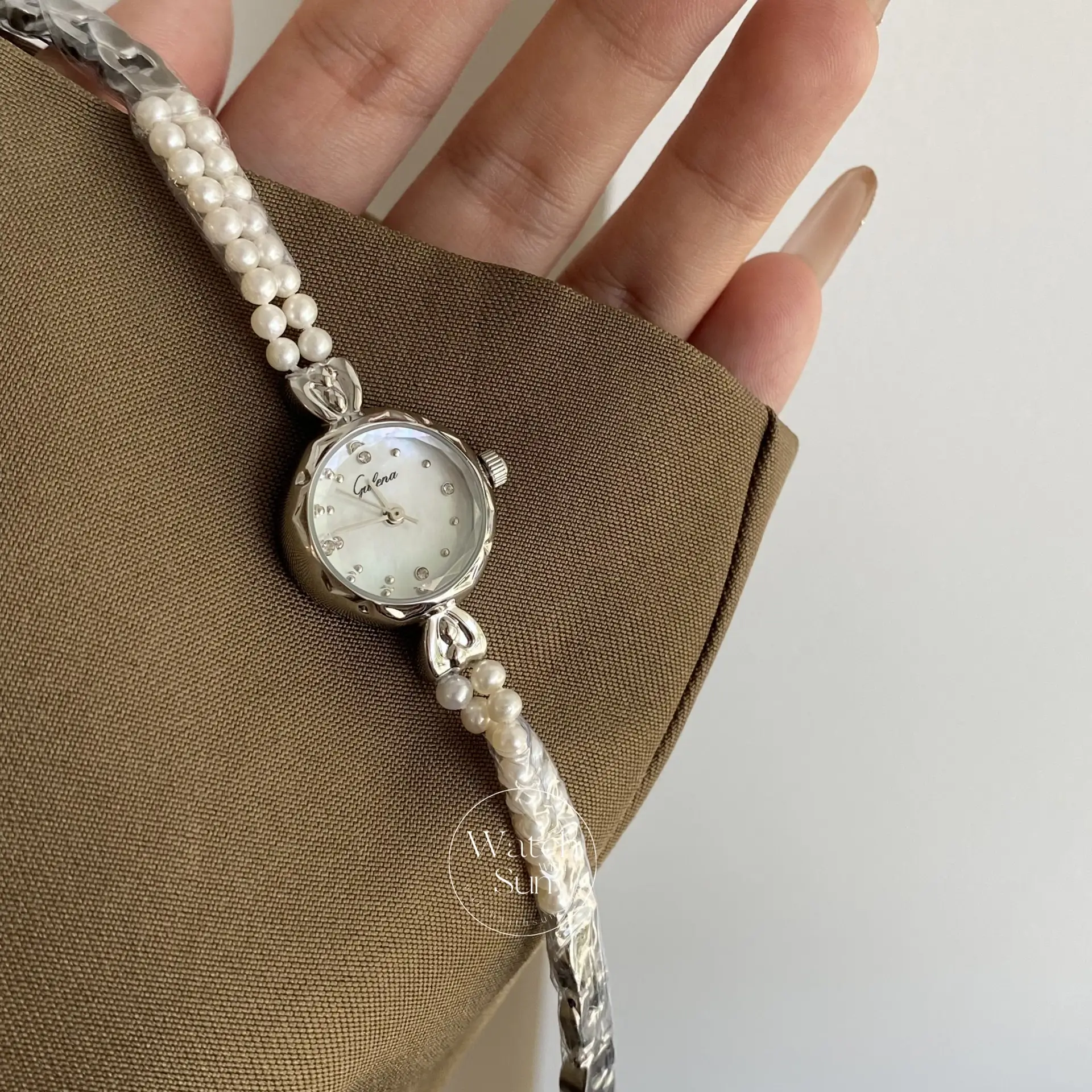
The same contrast shows up again at the dial. A dainty golden case, holding a mother-of-pearl face at the center, mirrors the exact tension the strap is already built on: hard metal framing something soft and luminous. Most jewelry either impresses immediately or rewards a second look — pearl watches tend to do a bit of both.
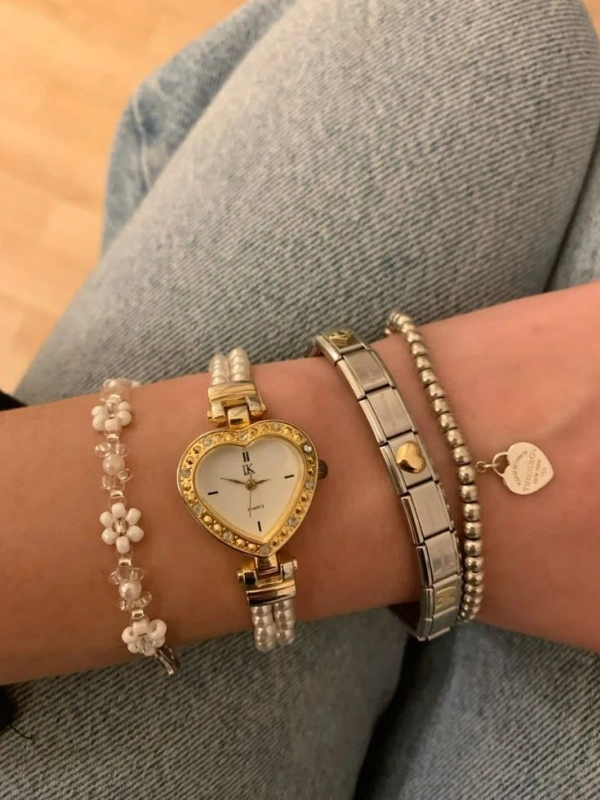
Heart-shaped gold pearl watch freshwater pearl watch with gold links and mother of pearl dial
Square gold pearl watch freshwater pearl watch with gold links and mother of pearl dial
Oval mother of pearl watch freshwater pearl watch with gold links and mother of pearl dial
They Work on Almost Everyone, Almost Everywhere
Pearls sit in an unusual color category. They’re not quite white, not quite cream, not really warm or cool in any strong direction — closer to a soft, neutral glow that shifts slightly depending on the light around it. That neutrality means a pearl watch doesn’t have to be matched to an outfit the way a colored stone might; it sits comfortably against nearly every palette, from all-black to pastel to deep jewel tones, without ever looking like the wrong choice.
The scale helps too. Pearl watches are almost always small and delicate rather than oversized, which puts them in a category that rarely feels like it’s trying too hard. A small pearl watch is proportioned to disappear into daily life rather than announce itself, which is exactly why it tends to get worn constantly instead of being saved for special occasions and then forgotten in a drawer. The same watch that looks right with a linen shirt on a Tuesday looks equally right at a dinner on Saturday, without anyone needing to think twice about whether it fits the moment.
It’s worth running through a few of those contexts directly, since “versatile” can otherwise stay a little abstract. At a desk, it reads as neat and unremarkable in exactly the way office jewelry should. At a wedding, where a lot of guests default to whatever feels safely dressy, it already looks intentional without trying too hard. On a weekend errand run, paired with something as plain as a t-shirt, it doesn’t look out of place either. Three very different settings, and the watch doesn’t need to change for any of them.
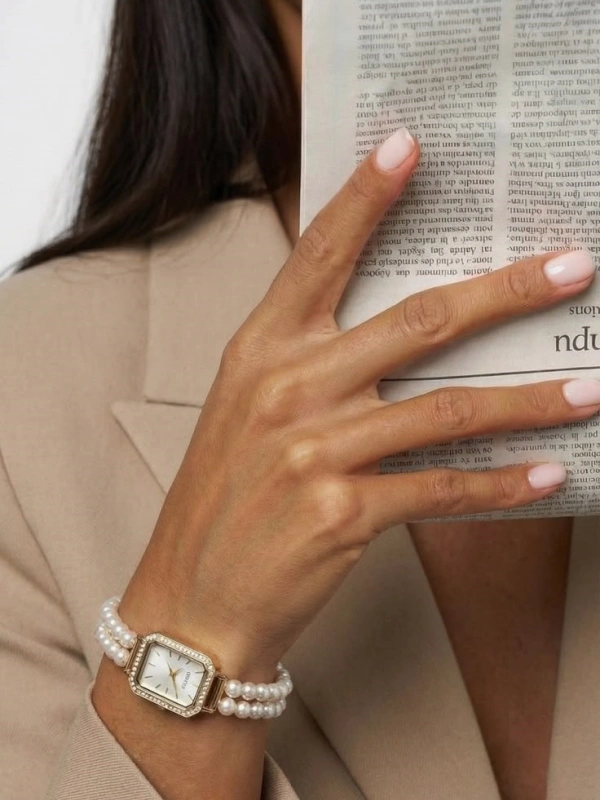
Square gold pearl watch worn on wrist holding newspaper paired with beige blazer
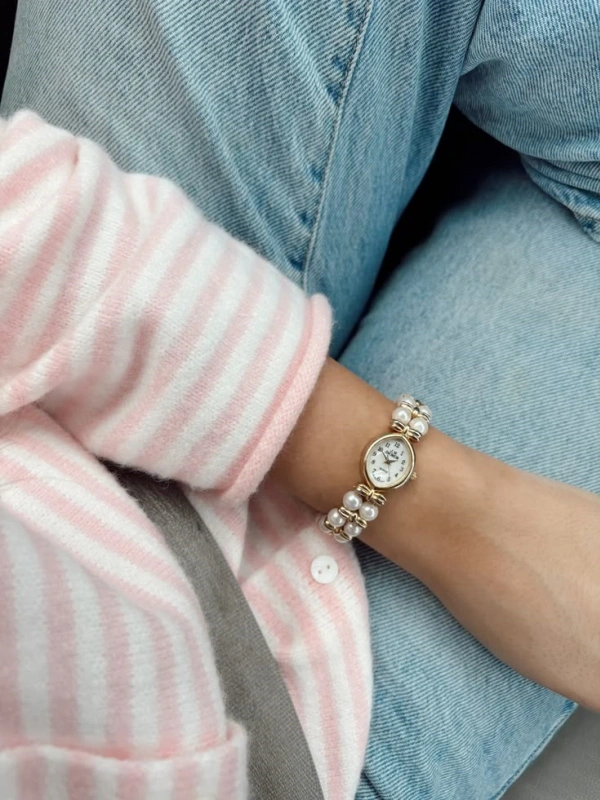
Oval gold freshwater pearl watch worn on wrist paired with pink striped shirt and jeans
The Detail That Catches Light and Holds Up Close
There’s also something specific happening with how pearls catch and hold light. Unlike a polished gemstone or a mirror-bright metal surface, pearls don’t throw off a hard, direct reflection. They glow instead — a soft, diffused luminescence that comes from the layered nacre just beneath the surface, catching ambient light rather than a single sharp point of it. That quality is part of why pearls have always photographed so gently under almost any lighting condition, from warm indoor bulbs to bright outdoor sun.
The mother-of-pearl dial extends that same quality inward. Look closely and the surface isn’t flat — it shifts in subtle color as the light moves across it, sometimes catching a faint hint of blue or pink beneath the white. That’s not a printed pattern; it’s the natural structure of the material doing exactly what it does in a shell, and it’s part of why a pearl watch tends to feel more alive than a printed or enameled dial, even at a glance.
Why It Has to Be Real Freshwater Pearl
Everything described so far — the glow, the subtle shifts of color, the way light moves across the surface instead of bouncing off it — depends entirely on the pearl being an actual pearl. Not every watch marketed as a “pearl watch” uses one. Plenty use plastic or glass beads finished to look pearl-adjacent from a few feet away, and at a glance, in a product photo, the difference isn’t always obvious. Up close, and over time, it becomes very obvious.
This is part of why our own pieces are made with real freshwater pearls rather than an imitation, across a fairly wide range of styles — small single-dial pieces, longer double-strand designs, versions with more pearls and versions with fewer. The specific silhouette changes from style to style, but the material underneath doesn’t, because the entire appeal described in this piece — the glow, the texture against metal, the way it photographs — only really works if the pearl is genuinely a pearl. Swap that one detail for an imitation and most of what makes the category work quietly stops working too, even if the shape on the wrist looks similar at first glance.
Dainty Gold Watch Elegant Freshwater Pearl Band Watch for Women
Dainty Freshwater Pearl Bracelet Watch Mother of Pearl Ladies Watch
A Natural Fit as a Gift
There’s one more reason pearl watches keep coming up so often, and it has less to do with the person wearing one and more to do with the person choosing it for someone else. Buying jewelry for another person is genuinely difficult — taste is personal, and a piece that feels exciting to the giver can easily miss the mark for the person receiving it. Pearls sidestep a lot of that risk. Because the color is neutral and the style has never been tied to one narrow aesthetic, a pearl watch doesn’t require knowing someone’s exact preferences the way a bold color or an unusual shape might.
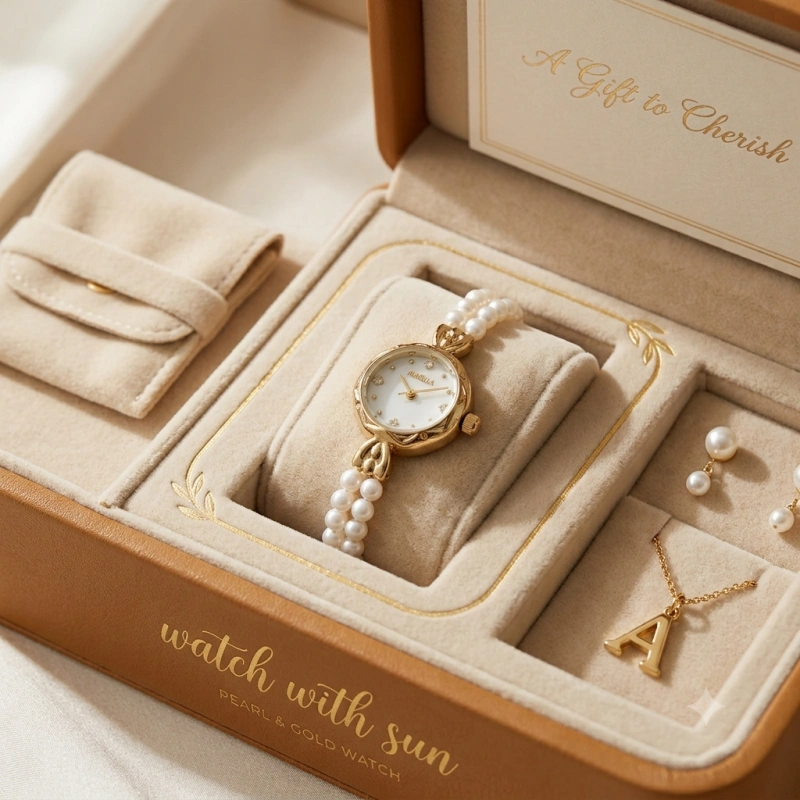
That makes it a fairly safe choice, but “safe” undersells what actually happens when someone opens the box. A pearl watch doesn’t read as a generic, play-it-safe gift the way some neutral choices can. It still feels considered — a genuine piece of jewelry, not just a functional object picked because it wouldn’t offend anyone’s taste. It works for a graduation, a birthday, an anniversary, or simply an occasion that doesn’t have a name, precisely because it isn’t trying to say one specific thing. It can mean whatever the moment calls for.
There’s also a practical layer to it that quietly helps: because it does the job of both a watch and a bracelet, giving one feels a little more substantial than giving a single, narrower piece of jewelry, without requiring the giver to guess at a specific style the recipient might not actually wear. It’s the rare gift that manages to feel personal and low-risk at the same time — which, for anyone who’s ever stood in front of a jewelry case trying to decide, is a genuinely useful combination to find in one object.
It also tends to travel well across relationships, which isn’t true of most jewelry. A piece built around a bold, specific style usually only works as a gift between people who already know each other’s taste closely — a parent, a partner, someone who’s paid enough attention to know exactly what the other person would pick for themselves. A pearl watch doesn’t demand that same level of familiarity. It works reasonably well from a close friend, a colleague marking a milestone, or a family member who wants to get something right without needing an insider’s knowledge of the recipient’s exact style. That’s a fairly rare quality in jewelry, and it’s a large part of why the category keeps showing up on gift lists in the first place.
Closing
None of this adds up to one dramatic reason pearl watches are popular. It’s closer to a dozen small ones, stacked on top of each other — a material that was already beloved long before it ever touched a watch strap, the way pearls read as jewelry rather than hardware, the contrast they create against metal, how easily they move between outfits and occasions, the way they catch light, and how naturally they work as something to give as well as something to wear. Individually, none of these would be enough to explain decades of steady appeal. Together, they explain almost all of it.
That’s probably the real answer to why pearl watches have always been popular. Not one loud reason, but a long list of quiet ones — inherited from pearls themselves, built into the watch, and carried forward every time someone reaches for one, whether it’s for their own wrist or someone else’s.
A watch, in the end, is one of the few pieces of jewelry someone is likely to wear almost every day, which makes the material sitting on it matter more than it might for something worn occasionally. Pearls happened to already be the material people trusted for exactly that kind of everyday closeness — and a watch, it turns out, was simply the next obvious place for that trust to go.
 Skip to content